
How much does motorcycle riding school training cost in Lusaka? If you’re planning to learn how to ride a motorcycle in Zambia, one of the first questions you’ll probably ask is: “How much will it cost me?”
The answer depends on the type of training you need, how many lessons you require, whether you already know how to ride, and whether your training package includes a motorcycle, instructor, theory preparation or licence-related assistance.
In this guide, we’ll break down motorcycle riding school training costs in Lusaka, explain what you should expect to pay, what affects the price, and what to look for when choosing a motorcycle riding school.
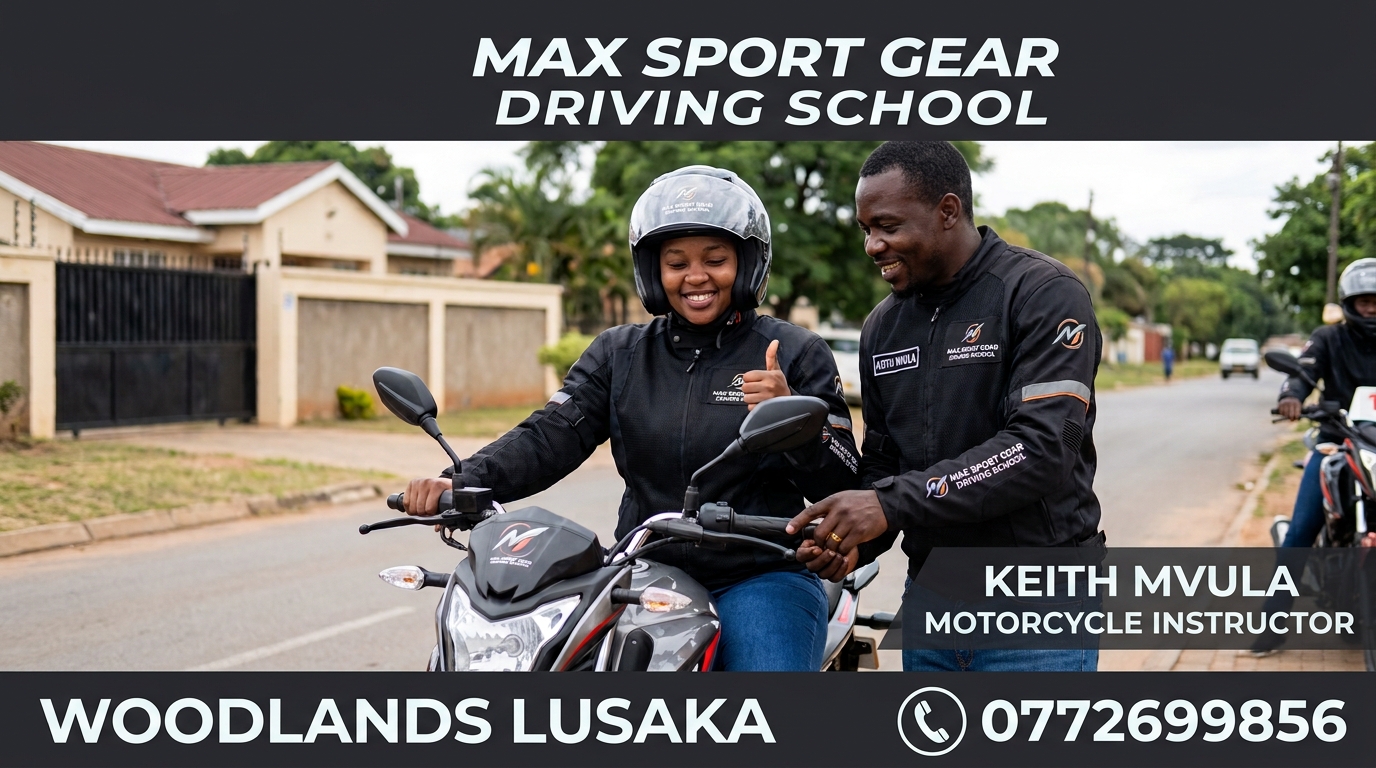
If you’re in Lusaka and looking for practical motorcycle training, we also have a motorcycle riding school in Woodlands, Lusaka, where you can train with Keith Mvula, a motorcycle instructor.
📱 WhatsApp Keith on +260 772 699 856
How Much Does Motorcycle Riding School Training Cost in Lusaka?
There isn’t one fixed price charged by every motorcycle riding school in Lusaka. Training providers set their own prices depending on the course structure, duration, equipment and services included.
For comparison, publicly advertised driving-school courses in Lusaka can range from around K2,000 to K4,000 or more, depending on the duration and level of training. For example, the Zambia Road Safety Trust currently advertises learner-driver courses from K2,100 for a shorter course to K3,000 for a 21-day full course.
However, motorcycle riding lessons are not necessarily priced the same as car driving lessons.
Motorcycle training can be structured differently because the student may require individual practical sessions, motorcycle-specific exercises and specialised rider instruction.
The best approach is therefore to ask the riding school exactly what is included before comparing prices.
What Determines the Cost of Motorcycle Riding Lessons?
Why can two motorcycle riding schools charge different amounts?
Several factors can affect the cost.
1. Your Riding Experience
A complete beginner will normally need more training than someone who has already spent months riding a motorcycle.
If you’ve never sat on a motorcycle before, your instructor may need to start with the basics:
- Motorcycle controls
- Starting and stopping
- Clutch control
- Throttle control
- Gear shifting
- Braking
- Steering
- Balance
- Slow-speed riding
An experienced rider looking for a refresher course may need considerably fewer lessons.
2. Number of Training Sessions
Some schools charge for a complete course, while others may charge per lesson.
A complete beginner might benefit from multiple sessions rather than trying to learn everything in one or two days.
Think of motorcycle riding like learning to swim. Someone can explain the technique to you in 30 minutes, but your body still needs time to develop the coordination and confidence.
3. Type of Motorcycle
Training on a small motorcycle can be different from learning on a larger motorcycle.
For example, a beginner learning on a small-capacity bike may find it easier to develop basic control before progressing to a larger motorcycle.
If you already own a motorcycle, you may also want to ask whether the instructor allows students to train on their own bike.
4. What Is Included in the Package?
Never compare prices based on the number alone.
A K1,500 package and a K2,500 package might appear very different, but what if the cheaper package includes only a few lessons while the more expensive one includes considerably more practical training?
Ask whether your fee includes:
- Motorcycle use
- Instructor fees
- Practical riding sessions
- Theory instruction
- Road training
- Safety training
- Test preparation
- Training materials
- Licence-related guidance
Motorcycle Riding School Training vs Learning From a Friend
Let’s be honest — many Zambians learn to ride motorcycles from friends, relatives or fellow riders.
And while having someone show you the basics can be useful, it doesn’t necessarily teach you how to ride safely and systematically.
A friend might teach you how to:
Start the bike → select first gear → release the clutch → accelerate.
But professional motorcycle training goes much further.
A qualified instructor can teach you how to identify hazards, position yourself correctly on the road, brake effectively, control the motorcycle at low speeds and develop defensive riding habits.
That’s particularly important when you’re eventually riding around Lusaka traffic.
What Should a Good Motorcycle Riding Course Include?
Before paying for motorcycle riding school training in Lusaka, ask what you’ll actually learn.
A comprehensive beginner course should ideally cover:
Motorcycle Controls
You should become familiar with the:
- Throttle
- Front and rear brakes
- Clutch
- Gear selector
- Indicators
- Horn
- Mirrors
- Kill switch
- Other essential controls
Basic Motorcycle Handling
You’ll need to practise:
- Starting
- Stopping
- Straight-line riding
- Turning
- Gear changes
- U-turns
- Slow-speed manoeuvres
- Controlled acceleration
Braking and Emergency Skills
Braking is one of the most important skills a motorcyclist can develop.
A good instructor should teach you how to brake progressively and how to respond when something suddenly appears in your path.
Road Riding
Once you’re comfortable controlling the motorcycle, you can begin developing road skills.
This includes:
- Lane positioning
- Observation
- Intersections
- Overtaking
- Following distances
- Traffic awareness
- Pedestrian awareness
- Hazard identification
- Defensive riding
Don’t Forget the RTSA Licence Costs
Your motorcycle riding school fee isn’t necessarily the same thing as the cost of obtaining your motorcycle licence.
RTSA currently lists the following fees for a provisional riders licence:
- Provisional riders licence — K117
- Practical driving test — K87
- Licence printing after passing — K144
That makes the currently listed RTSA fees K348, before considering medical certification and motorcycle riding lessons.
RTSA also states that the provisional riders licence requires a medical certificate, identification such as an NRC or passport, and that applicants must be at least 16 years old.
So when calculating your overall budget, think of the cost as two separate parts:
Motorcycle training + government/licensing costs = your overall budget.
Government fees can change, so always confirm the current charges with RTSA before paying.
How Many Motorcycle Riding Lessons Do You Need?
This is one of the most common questions beginners ask.
There isn’t a universal number.
One student may become comfortable after several sessions, while another may need more practice.
Your required training time depends on:
- Previous riding experience
- Coordination
- Confidence
- Motorcycle type
- How frequently you practise
- Your ability to control th